Test Data Platform For Regulated Enterprises
Deterministic, reproducible test data for banks and insurers, including valid SWIFT messages, generated on demand and integrated into your CI/CD, without production data ever leaving your environment. DATAMIMIC Enterprise supports customer-specific ISO 20022 message generation through its configurable template framework.


Protecting sensitive customer information during testing is a major challenge, and the risk of a data breach from using production data is significant. Our platform provides ultimate security through a sophisticated, model-driven approach. We offer two paths to PII-safe test data: fully synthetic generation where no production data is read or referenced at any stage, and field-level pseudonymization and anonymization tooling that transforms source data before it ever reaches the target system. The result is test data that has the complexity of real data but keeps sensitive customer information out of test environments, supporting your compliance obligations under GDPR and other privacy regulations. Whether output meets GDPR anonymization standards depends on model configuration and a re-identification risk assessment conducted by the data controller.
Regulated enterprises need test data tools that fit their environment, including on-premise and air-gapped deployments. We designed DATAMIMIC for exactly that. The platform runs fully offline via podman-compose or Helm chart on OpenShift or Kubernetes, with connectors for PostgreSQL, Oracle, MongoDB, Apache Kafka, and file formats including CSV, JSON, XML, EDIFACT, SWIFT MT, and HL7. Our API-first approach means you can call for and receive test data directly within your CI/CD scripts using the built-in task runner and scheduler. No telemetry, no call-home, no cloud dependencies: your data stays in your environment, and every generation is logged and replayable for audit without costly infrastructure changes.
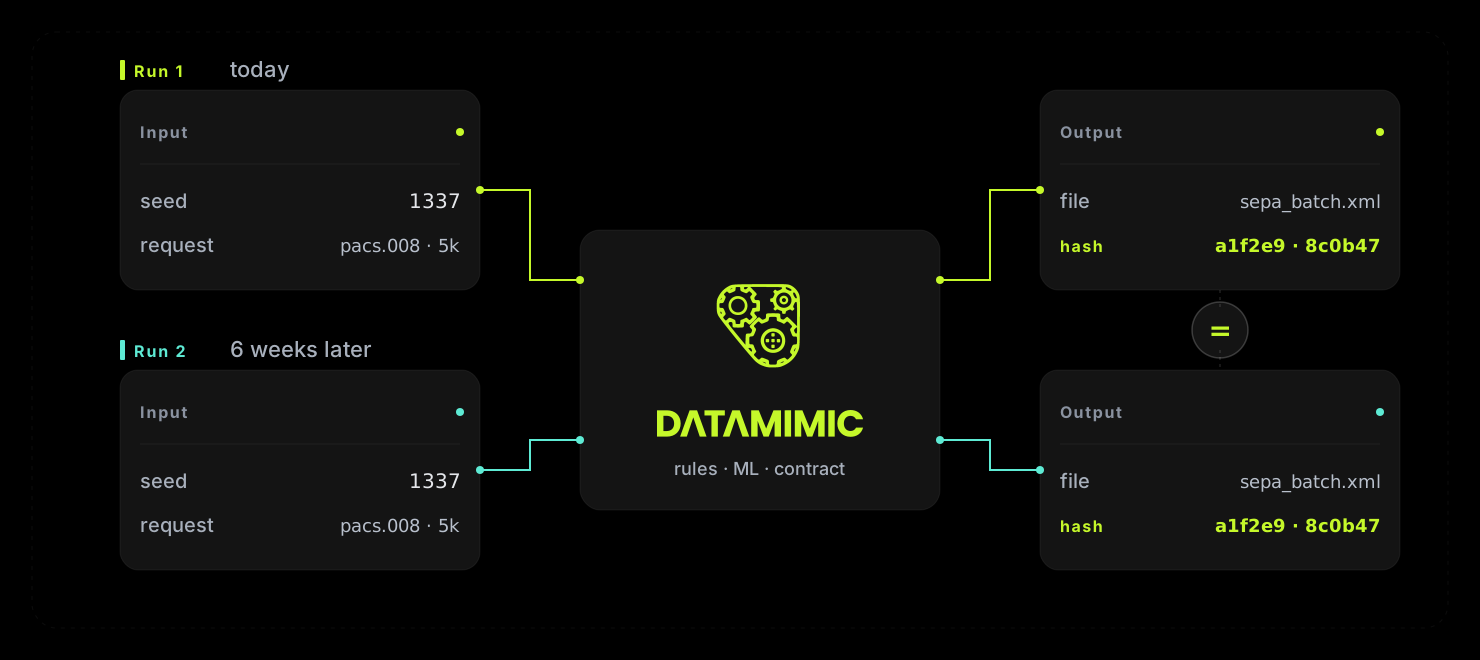
Waiting on a DBA ticket for test data stalls a sprint. DATAMIMIC gives engineering and QA teams governed self-service: generate fresh, PII-safe data on demand, isolated per developer, without touching production. It plugs into your CI/CD through a REST API and a built-in scheduler, so data arrives as part of the build from the first sprint. Seeded, rule-based generation supports reproducible datasets under controlled execution conditions. ML-generated data does not carry the same byte-identical replay guarantee. When requirements shift mid-sprint, you generate targeted edge cases or a full regression set without starting over. Every run is logged for audit.
Unlock Model-based Test Data Generation with DATAMIMIC UI
Build and manage your data models in the DATAMIMIC UI. The interface covers the full workflow from data discovery to synthetic data generation, so teams can define, version, and run models without hand-writing every script.
To get started, connect to your databases or upload JSON files to auto-generate your DATAMIMIC models. The visualization layer gives you precise control over data quality checks and referential integrity enforcement. Every generated dataset keeps its structure and relationships intact, aligned with GDPR Art. 25 and DORA traceability requirements.
Complex JSON Capabilities and Templating
Modern applications increasingly rely on complex nested data structures, requiring advanced approaches to ensure accuracy and performance. DATAMIMIC optimizes software testing for these environments, offering specialized capabilities for applications that rely on semi-structured data. We purpose-built our platform for MongoDB and NoSQL databases, addressing unique challenges that traditional tools struggle with, particularly in MongoDB testing scenarios.
With DATAMIMIC, you can upload your JSON schema and use our built-in generators, custom scripts, and templating variables for replication. This delivers precise control over complex hierarchies, ideal for creating robust data validation scenarios mirroring your application’s logic and structure.

DATAMIMIC combines model-driven generation with the flexibility your teams already have. Bring existing Python scripts and reuse them as generators, converters, or validators alongside the platform’s built-in models. No rewrite, no migration project. Performance-critical paths run on a Rust fastpath: validation, hashing, and high-volume serialization happen at near-zero overhead. For workloads beyond a single machine, generation distributes across Ray clusters with linear throughput as nodes scale. The result: deterministic pipelines that match existing engineering patterns, integrate with the Python tooling teams already trust, and run as fast as your infrastructure allows.
Most test-data tools treat a payment as generic data to mask. DATAMIMIC generates it as a message. DATAMIMIC Enterprise generates SWIFT MT messages (MT103, MT202 COV) with correct IBAN and BIC and a traceable UETR, and supports customer-specific ISO 20022 message generation, such as pacs.008 and pain.001, through its configurable template framework. When both formats are configured, the same payment renders as MT and as ISO 20022, so you can test an MT-to-MX migration against ground truth. Generated messages are intended for test and training environments, not for transmission on production SWIFTNet networks. Seeded, rule-based generation is reproducible in CI under controlled execution conditions.
Get the DATAMIMIC news
It’s a free collection of tips we don’t share elsewhere. Learn first-hand insights on tricks and tweaks for your test data project! Not sure? Try now!

We’ve received your submission and will be in touch shortly
Enhance your development today with realistic test data. Accelerate your project timelines, and uphold data privacy as a fundamental right with DATAMIMIC
DATAMIMIC is a test data platform for banks, insurers, and regulated enterprises. We generate, anonymize, pseudonymize, and migrate data for development, testing, and training with full determinism and audit trails. Our model-driven approach produces reproducible, PII-safe datasets that satisfy GDPR, DORA, BCBS 239, and PCI DSS requirements. With on-premise and air-gapped deployment and no production data ever leaving your environment, DATAMIMIC gives regulated teams the test data they need without the compliance risk of using real production data.
Learn more in our DATAMIMIC factsheet
Learn simply more about DATAMIMIC, the powerful DATAMIMIC UI, and our DATAMIMIC packages to shape your test data universe smart and safely. Additionally, we provide guidance, code snippets, and more to get you started fast with a steep learning curve. Finally, get your DATAMIMIC factsheet, improve your test data and ultimately speed up your development.
Need help deploying DATAMIMIC?
Frequently Asked Questions.
How to create complex data for testing?
DATAMIMIC uses a model-based approach to synthetic data generation. Rather than scripting data by hand, our platform analyzes your source data (or a provided schema) to learn its statistical properties, distributions, and relationships. From this, it generates entirely new synthetic data that mimics this complexity. Seeded, rule-based generation supports reproducible datasets under controlled execution conditions. ML-generated data does not carry the same byte-identical replay guarantee. For example, it can replicate intricate nested JSON structures while maintaining the relationships between customers and orders in a relational database. This referential integrity is critical for test validity and ensures data is realistic enough for even the most complex regulated test scenarios.
What is the difference between data anonymization and pseudonymization?
This is a critical distinction under regulations like GDPR. Anonymization alters data so individuals cannot be re-identified, even when combined with other information. This data is no longer considered personal data. Pseudonymization replaces direct identifiers (like a name) with a pseudonym (like a random user ID). The data can still be linked back to the individual with additional, separately kept information. Pseudonymous data is still considered personal data under GDPR. DATAMIMIC supports both techniques but excels at generating fully anonymized synthetic data, offering maximum privacy protection by design.
Is synthetic data as good as real data for testing?
For testing purposes, high-quality synthetic data often outperforms real data. A copy of production data provides a snapshot, but it carries real risks: it contains PII, often lacks edge cases, and reflects bias from the source. In contrast, model-generated synthetic data from DATAMIMIC preserves the statistical patterns of real data without the privacy risk. You can also augment synthetic datasets to add specific edge cases, balance classes to improve model training, and ensure comprehensive test coverage that production data alone might not provide.
How does DATAMIMIC help with GDPR and other data privacy regulations?
Using copies of production data for testing is a major compliance risk under GDPR, as it exposes sensitive personal data to a wider audience and increases breach risk. DATAMIMIC solves this by enabling a “privacy by design” approach. By generating synthetic test data that is statistically similar to production but contains no real PII, you remove the source of the risk entirely. This means your developers and testers get the realistic data they need to build and validate software, without ever accessing sensitive customer information. Your testing environments stay aligned with major data protection regulations.
Can DATAMIMIC work with our existing databases and CI/CD tools?
Yes. DATAMIMIC is built for enterprise ecosystems and designed for integration. It supports both SQL and NoSQL databases, including PostgreSQL, Oracle, and MongoDB, as well as streaming platforms like Apache Kafka. It also offers API endpoints to integrate directly into your CI/CD toolchain, including Jenkins, GitLab CI, and Azure DevOps. This enables fully automated data provisioning: fresh, compliant test data is delivered to your test environments as part of your normal build and deployment process, eliminating manual steps and delays.
Can DATAMIMIC run on-premise or in air-gapped environments?
Yes. DATAMIMIC runs completely offline, with no internet connection required at runtime. There is no telemetry, no license call-home, and no cloud dependencies. Deploy via podman-compose for single-host setups, or via Helm chart on OpenShift or Kubernetes for production clusters. Container images are small: server 250 MB, worker 750 MB, scheduler 150 MB. Updates follow your organization’s standard controlled-transfer process: pull new images, transfer them into your environment, and redeploy. This makes DATAMIMIC suitable for even the most restricted banking and public-sector environments.
How does DATAMIMIC support DORA and BCBS 239 compliance?
DATAMIMIC produces deterministic, reproducible test data with full audit trails, directly aligned with the traceability, accuracy, and resilience testing requirements of DORA and the data lineage principles of BCBS 239. Every generation run is logged with task ID, timestamps, model version, and content hash. Tasks are replayable from the seed, so any dataset can be reconstructed months later with byte-identical output. When proof is missing, the system blocks the operation: no silent fallback. This gives your audit and risk teams the evidence they need without additional instrumentation.
How does DATAMIMIC work with AI agents like Claude and Cursor?
DATAMIMIC’s XML-based DSL is designed to be agent-friendly. We provide a Claude Code skill for the DATAMIMIC DSL, so AI agents can help developers write, validate, and lint data generation models directly in their editor. The important distinction: agents help developers work faster, but the generation itself stays fully deterministic, explainable, and auditable, never black-box ML output.
Does DATAMIMIC support ML-based data generation?
Yes. When statistical fidelity matters more than rules can capture, such as customer demographics, transaction distributions, and claim frequencies, DATAMIMIC includes ML generators as a first-class part of the platform.
Our approach: ML is a tool in the toolkit, not a black box. Every ML generator is trained, versioned, and evaluated inside DATAMIMIC. Each run produces quality and privacy metrics plus per-column drift detection. When quality falls below the configured thresholds, the run is flagged explicitly before it reaches production. Rules give you determinism by default. ML gives you statistical realism where you need it. Both live under the same versioning, evidence, and governance layer.