Home › DATAMIMIC vs Tonic.ai: Which Job, Which Tool?
DATAMIMIC vs Tonic.ai: Which Job, Which Tool?
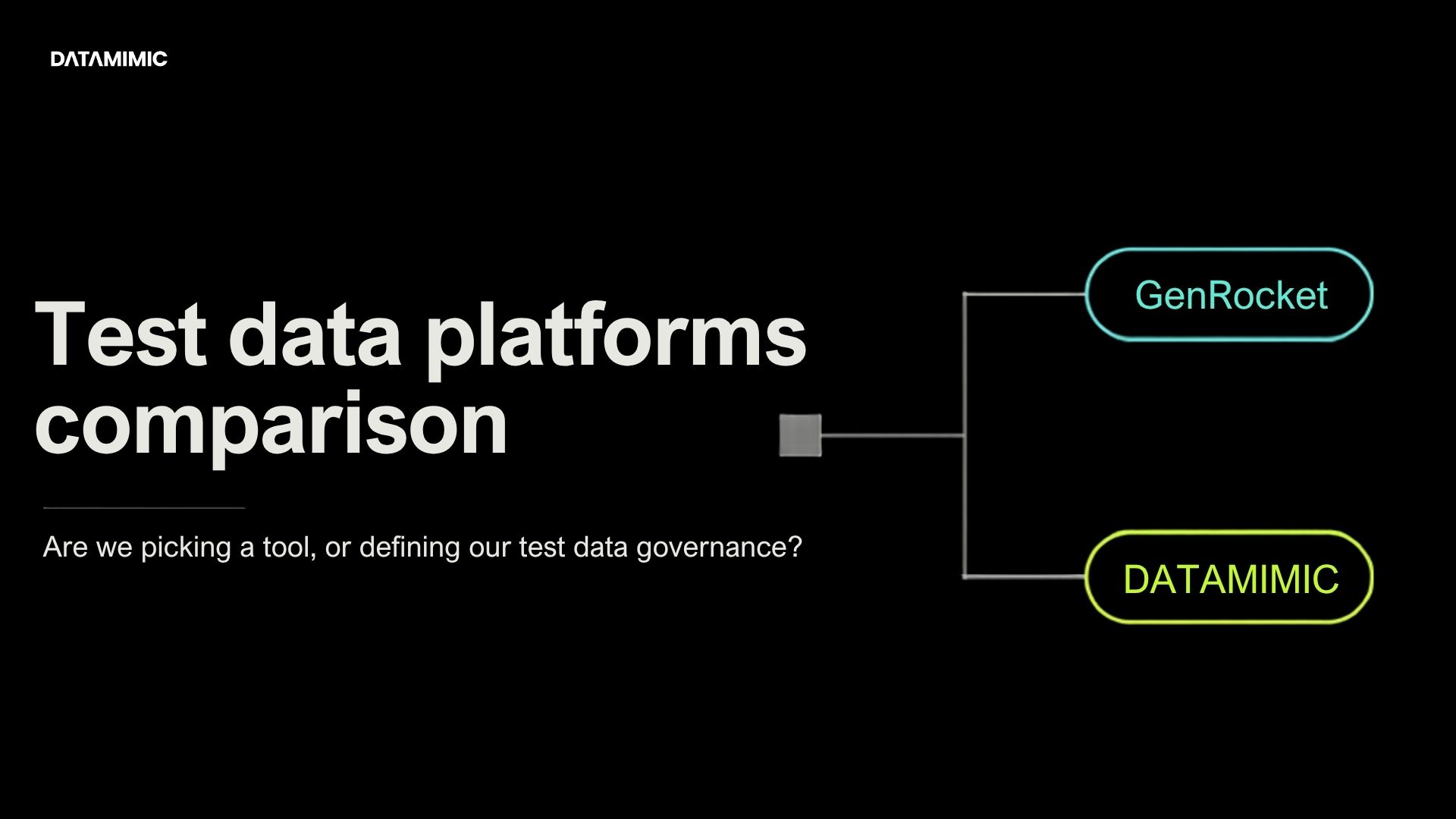
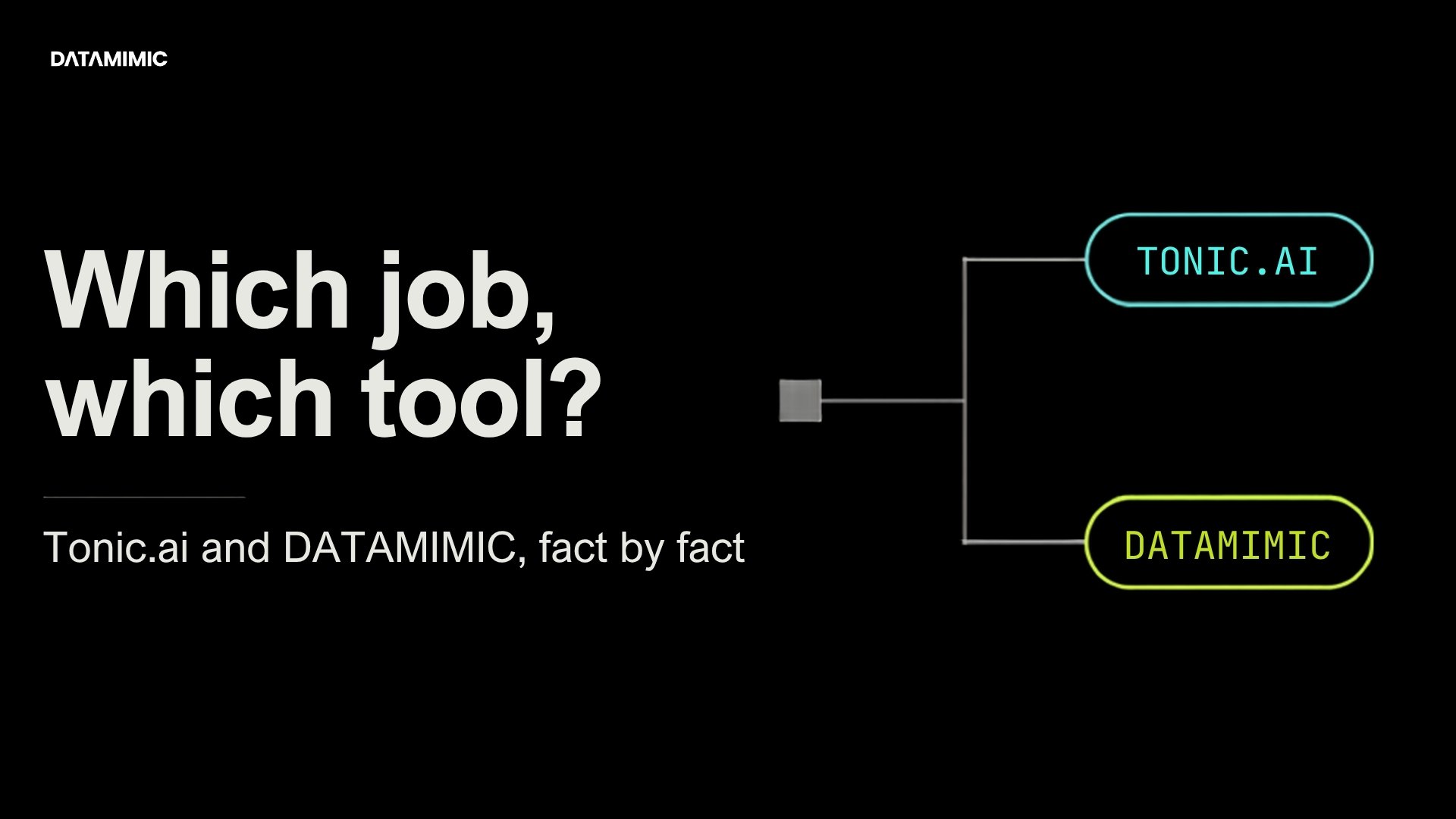
This is not a “which is better” post. Tonic.ai is a real product with real strengths, and pretending otherwise would insult your intelligence. When you are evaluating Tonic AI competitor, the useful question is which job you have. If you know the job, the tool choice mostly makes itself. Here is the comparison, fact by fact.
Last verified: July 2026. Every Tonic.ai claim below is sourced from Tonic’s own public documentation and pricing page, linked inline; every DATAMIMIC claim is checked against the installed CE 4.0.0 package and its bundled documentation. Where we could not verify a claim, we say so instead of guessing.
Quick verdict
|
Dimension |
Tonic.ai |
DATAMIMIC |
|
Byte-identical output as a stated default |
Deterministic masking exists per docs; default status and byte-vs-value-level guarantee undocumented |
CE default: engine version + model + seed → byte-identical, verified by golden tests |
|
Model authoring |
UI-primary (Structural); JSON export for backup/scripting |
Code-first XML DSL from day one (CE); Simple/Advanced UI modes sit on top (Platform) |
|
Unstructured text / PDF de-identification |
Yes, dedicated product (Tonic Textual) |
Not a focus area |
|
SWIFT MT / EDIFACT / HL7 message generation |
Not documented |
Enterprise Platform template engine, test/training use only |
|
ISO 20022 (pacs.008, pain.001) |
Not documented |
EE template framework, built per customer engagement, not a stock item |
|
Streaming targets (Kafka, RabbitMQ) |
Not documented |
EE only |
|
Self-serve free entry point |
Yes, Tonic Fabricate free tier |
Yes, CE via pip, MIT-licensed |
|
Adoption model |
Three products, adopted per workload |
One Platform adopted as the org-wide standard; CE as the engineer’s entry point |
|
Open-source execution core |
No |
Yes, CE, MIT license |
The rest of this post is the reasoning behind each row of this Tonic AI competitor breakdown, with sources.
What does Tonic.ai actually offer?
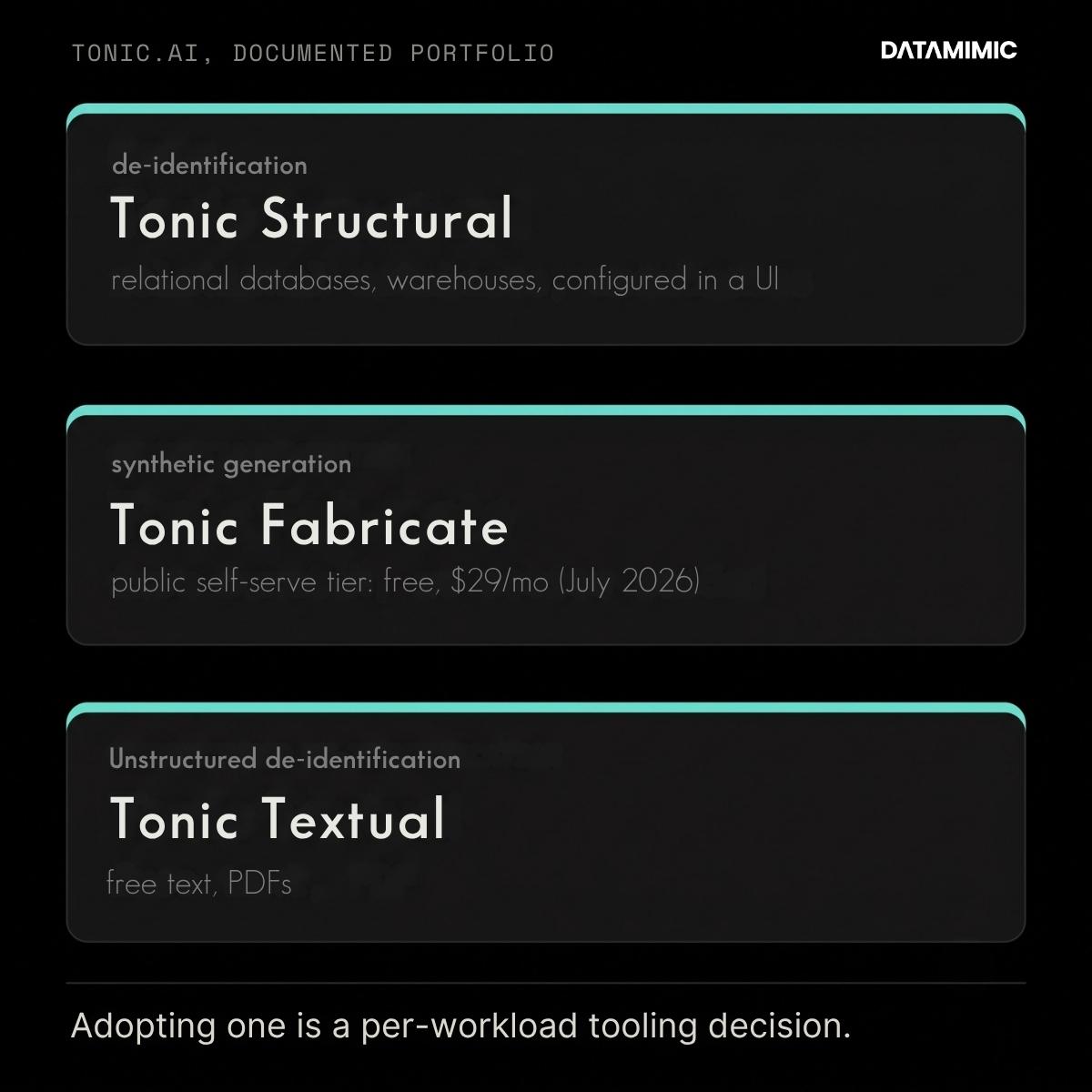
Three products, per Tonic’s own documentation and pricing page.
- Tonic Structural de-identifies relational databases and data warehouses, configured through a UI (their Database View, with per-column and bulk generator assignment).
- Tonic Textual de-identifies unstructured data: free text, PDFs.
- Tonic Fabricate generates synthetic data and has a public self-serve tier: free, and a paid plan priced at $29/month as of July 2026 per Tonic’s pricing page, alongside a custom-priced Enterprise tier.
All three offer self-hosted Enterprise deployment per their own docs, so “Tonic is SaaS-only” would be false and we will not claim it. Their official Fabricate client is Python, and they document integrations with OpenAI’s Agents SDK and LangChain.
That is a serious portfolio for developer-facing de-identification, and Fabricate belongs on any shortlist of Tonic AI competitor tools for synthetic test data generation. The differences that matter sit elsewhere.
Is the output deterministic, and is that the default?
This is the first real fork in the road, and it is where deterministic data masking and deterministic generation get quietly conflated.
Tonic’s own documentation describes deterministic masking as one available technique. What their docs do not specify is whether it is the default, or whether “deterministic” means byte-identical output or merely consistent value mappings. Those are different guarantees. Consistent mappings keep joins working. Byte-identical output lets you diff two runs, hash a file in CI, and hand a regulator the same evidence twice.
DATAMIMIC Community Edition makes the stronger guarantee the default and states its bounds:
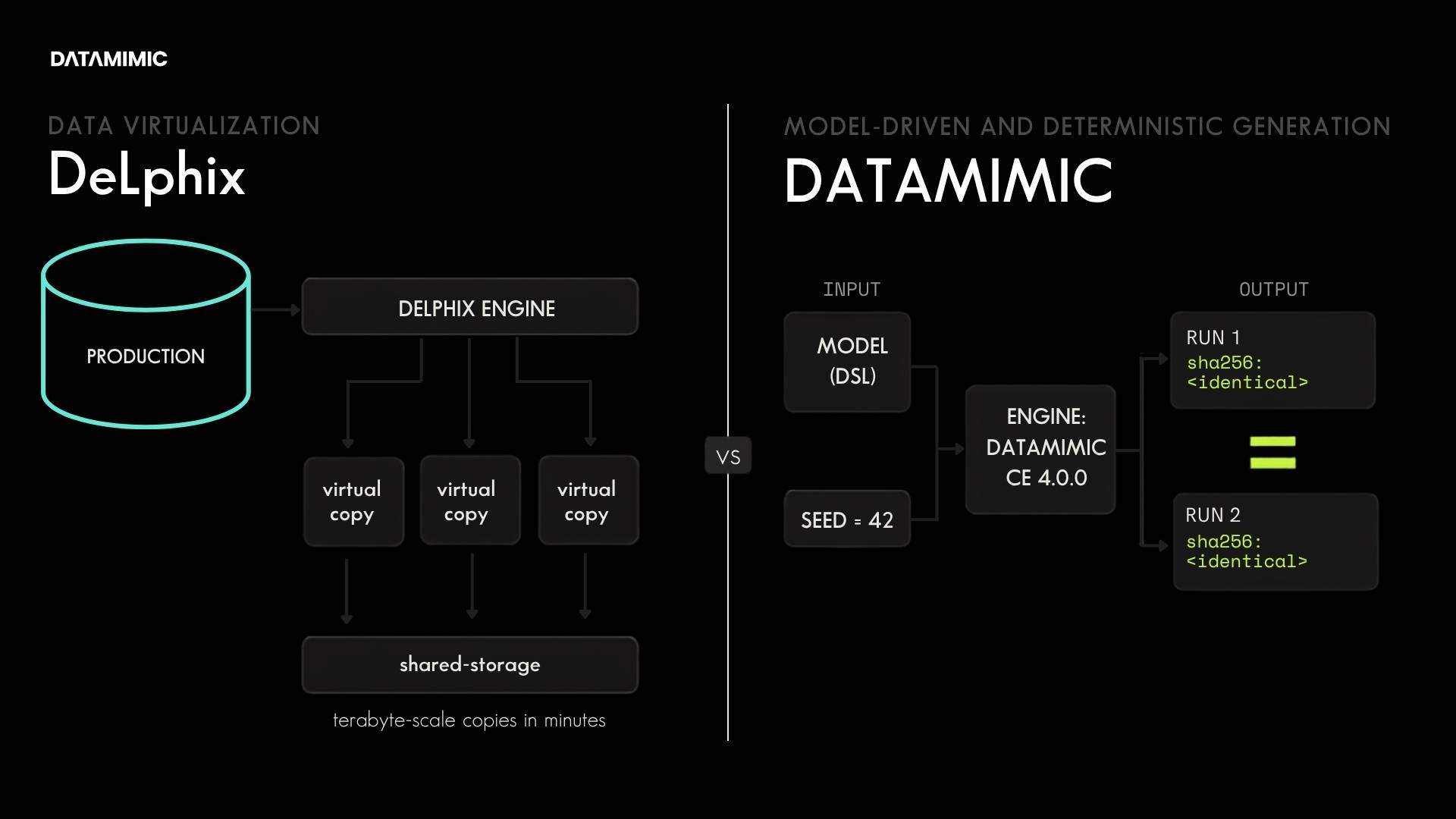
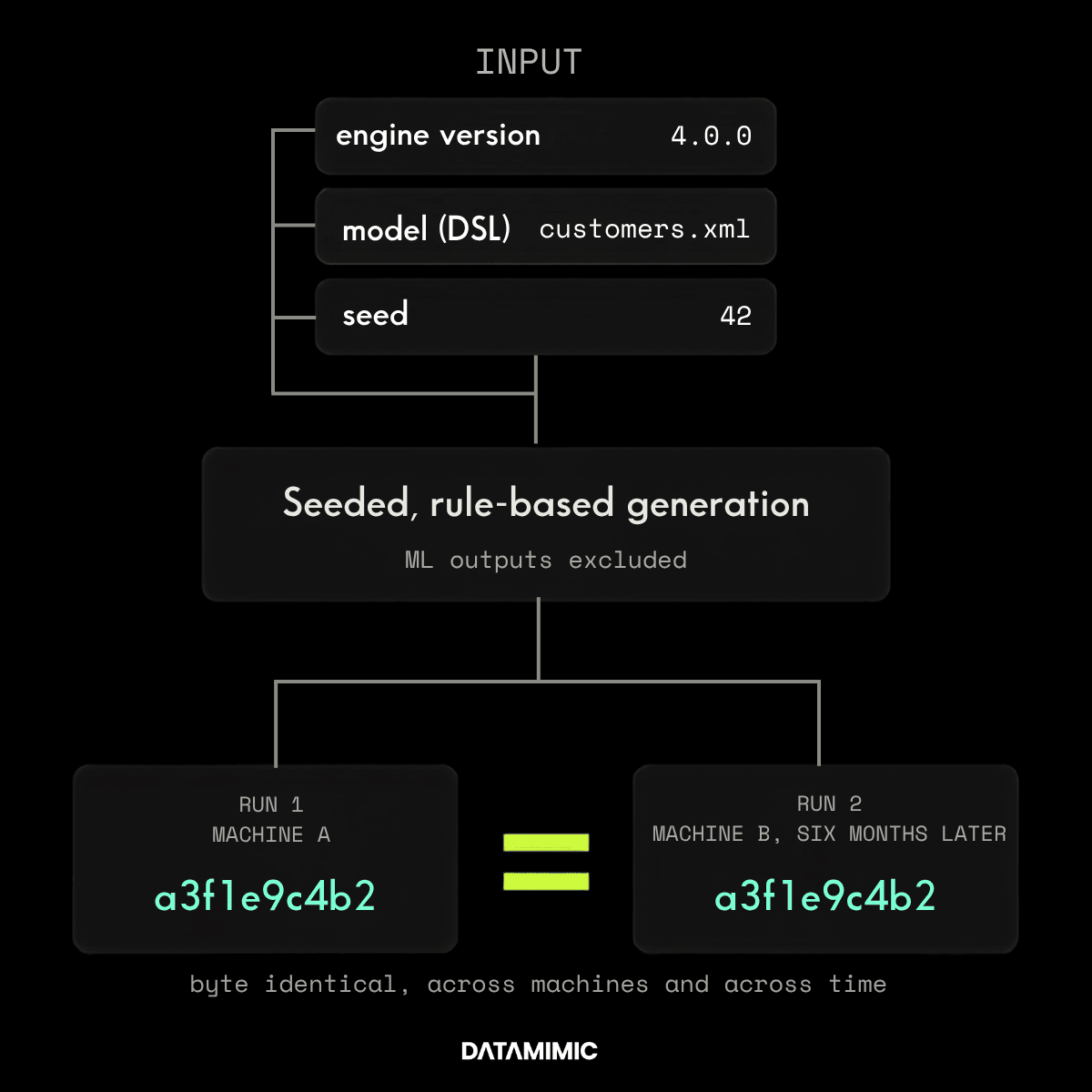
Same engine version + same model (DSL) + same seed → byte-identical output, across machines and across time.
Three inputs, verified by golden tests. It applies to seeded, rule-based generation only; ML outputs are statistically consistent, never byte-identical, and we do not put them under this claim. If a colleague on a different machine gets a different hash, one of the three inputs changed. That is the whole debugging model, and it is why the claim survives a bank’s proof of concept.
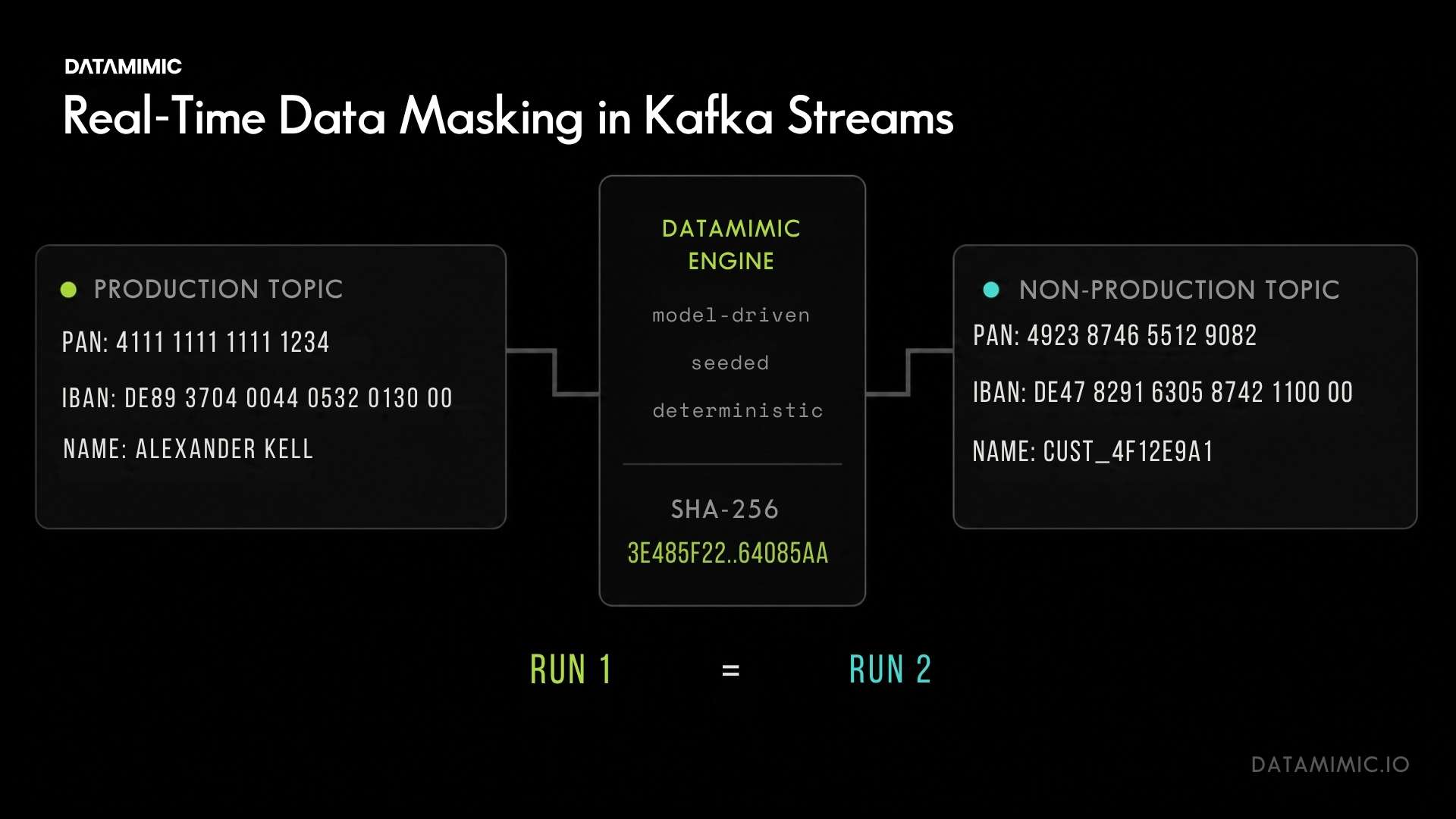
De-identification consistency has its own guarantee in CE, separate from the seed: identifier pseudonymization is value-keyed; the same value maps to the same pseudonym across every topic, by construction. Not “usually consistent”. By construction.
Who authors the model: the UI or the engineer?

Tonic Structural is UI-primary. You configure workspaces, columns, and generators in the interface. Configuration exports to JSON, and their own docs describe that export as a way of preserving a version before testing changes and of using a script to make changes to an exported file. Backup and scripted patching, not the primary authoring workflow. That is a legitimate design choice, and for teams who want to click through a schema it is a fast one.
DATAMIMIC CE inverts it. The model is an XML DSL, authored as code from day one, human-readable, Git-versionable. The model is the reviewable artifact: a pull request on a test data model gets the same review, diff, blame, and rollback as any other code. Custom logic plugs in as Python through Generator, Converter, and Validator interfaces. When an auditor asks what happened to a field, you show the line in the model. CE itself is MIT-licensed and installable via pip today; nothing in this section requires a sales conversation to try.
The DATAMIMIC Platform adds a graphical Simple Mode on top for visual model assembly, and an Advanced Mode where the same model is shown and edited directly as code. The UI is a view onto the artifact. The artifact stays code.
One integration note: Tonic documents OpenAI Agents SDK and LangChain integrations. DATAMIMIC focuses on context-efficient agent discovery with a compact, versioned capabilities index and explicit drill-down for detail.
Can it generate valid banking messages?
Tonic’s documented focus is relational databases, warehouses, and unstructured text. We found no documented SWIFT, ISO 20022, or EDIFACT support in their materials, and we will not invent one.
That comparison only stays fair if we scope our own side just as tightly. DATAMIMIC CE, the free MIT-licensed engine described above, does not generate banking messages either; that capability lives one tier up. DATAMIMIC’s Enterprise Platform template engine generates MT103 and MT202 COV (SWIFT MT), EDIFACT, and HL7 as deterministic test and training artifacts, traceable back to their source model. The limit that comes with it matters as much as the capability: this output is for test and training environments only, not network-validated, and must not be transmitted on production SWIFTNet or EDI networks; SWIFT MT output does not satisfy SWIFT CSCF v2025 secure-zone controls. ISO 20022 formats, including pacs.008 and pain.001, are not a stock catalogue item at all: they are built on that same template framework per customer engagement, which is a different promise than “ships out of the box.”
What does "model" mean at DATAMIMIC?
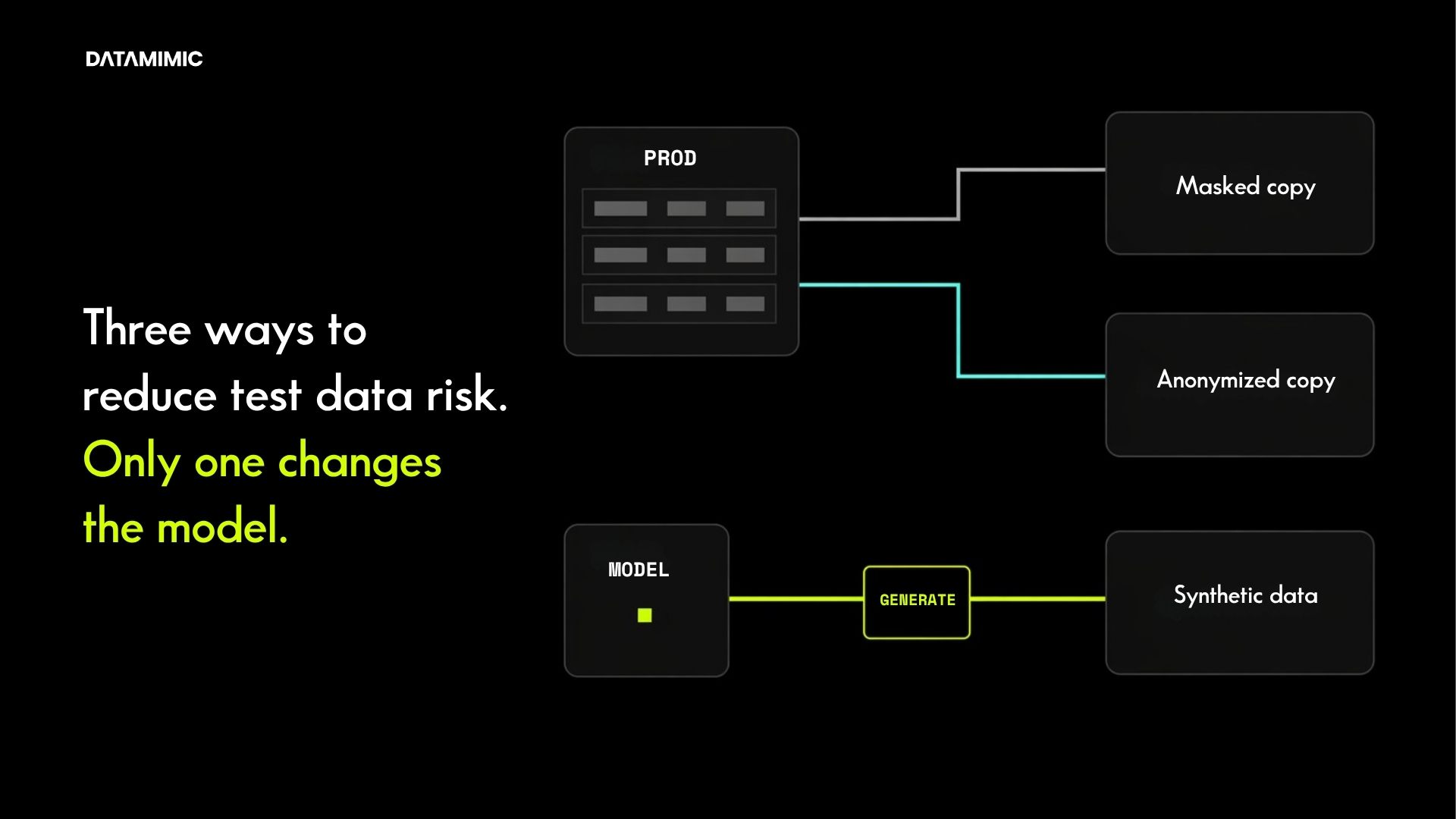
At Tonic, masking, synthetic generation, and unstructured de-identification are three products. At DATAMIMIC, they converge on one artifact, the model, and the Platform generates that artifact from your real landscape. The capabilities below are Platform features, on top of the CE/EE engine.
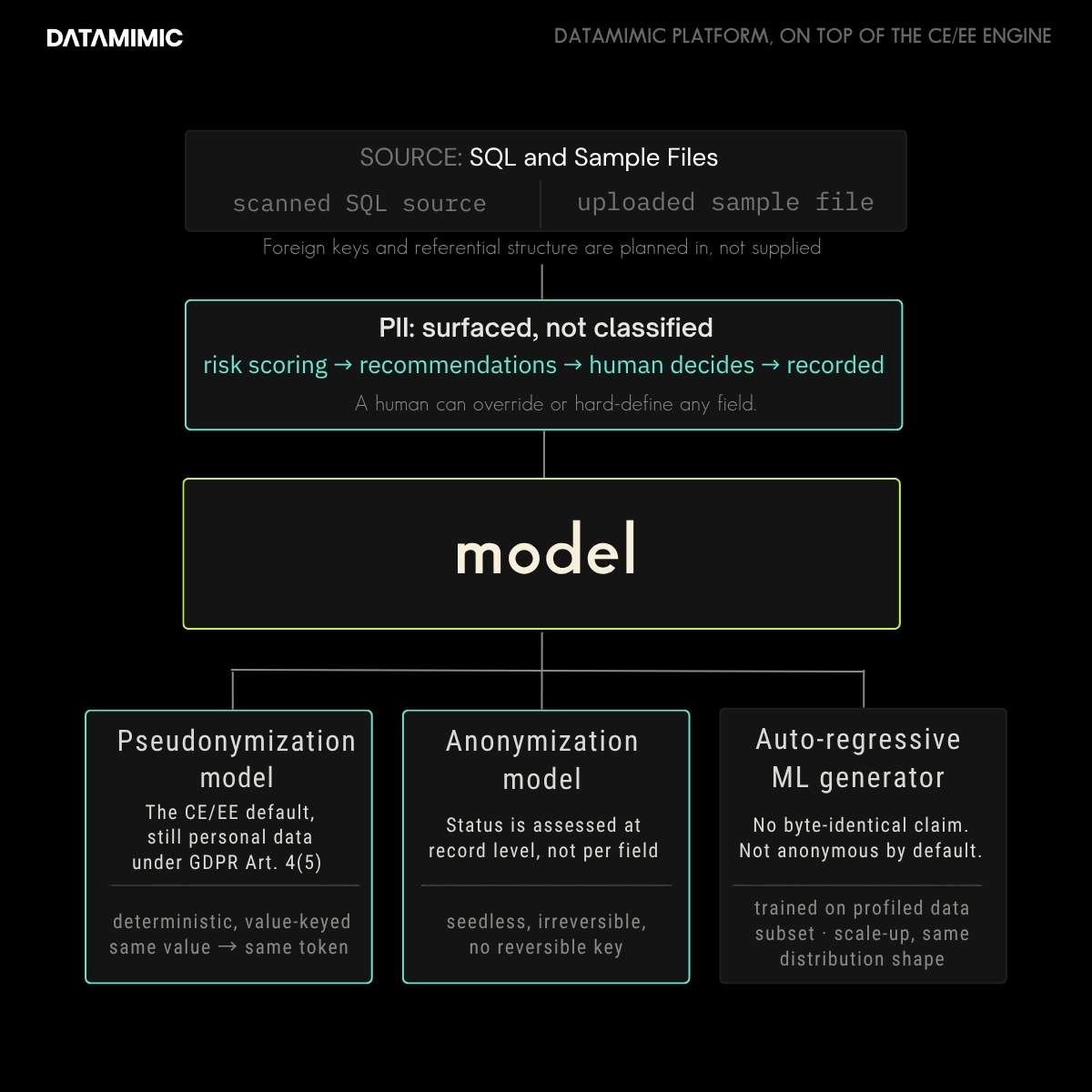
The Database View scans SQL data sources including complex relationships. For SQL databases it plans in foreign keys and referential structure, so the generated model preserves them. From a scanned source, or from an uploaded sample file such as a CSV, it generates two distinct model types, and the distinction is legal, not cosmetic: pseudonymization models (deterministic, value-keyed, the CE/EE default, still personal data under GDPR Art. 4(5)) and anonymization models (seedless, irreversible, no reversible key). We never use the two words interchangeably, because a GDPR reviewer will not either.
The Platform can also train auto-regressive ML generators on profiled data and generate new data that preserves the learned statistical distribution. That works in both directions: a smaller representative subset, or scaling a dataset up past the source volume at the same distribution shape for load testing. ML output carries no byte-identical claim, and it is not anonymous by default; that stays a tested, record-level question.
On PII: the Platform surfaces likely-PII fields through risk scoring and recommendations. A human review can override or hard-define any field, and the decision is recorded. We do not claim automatic PII classification, because silent auto-classification is precisely what a data protection officer should refuse to sign off.
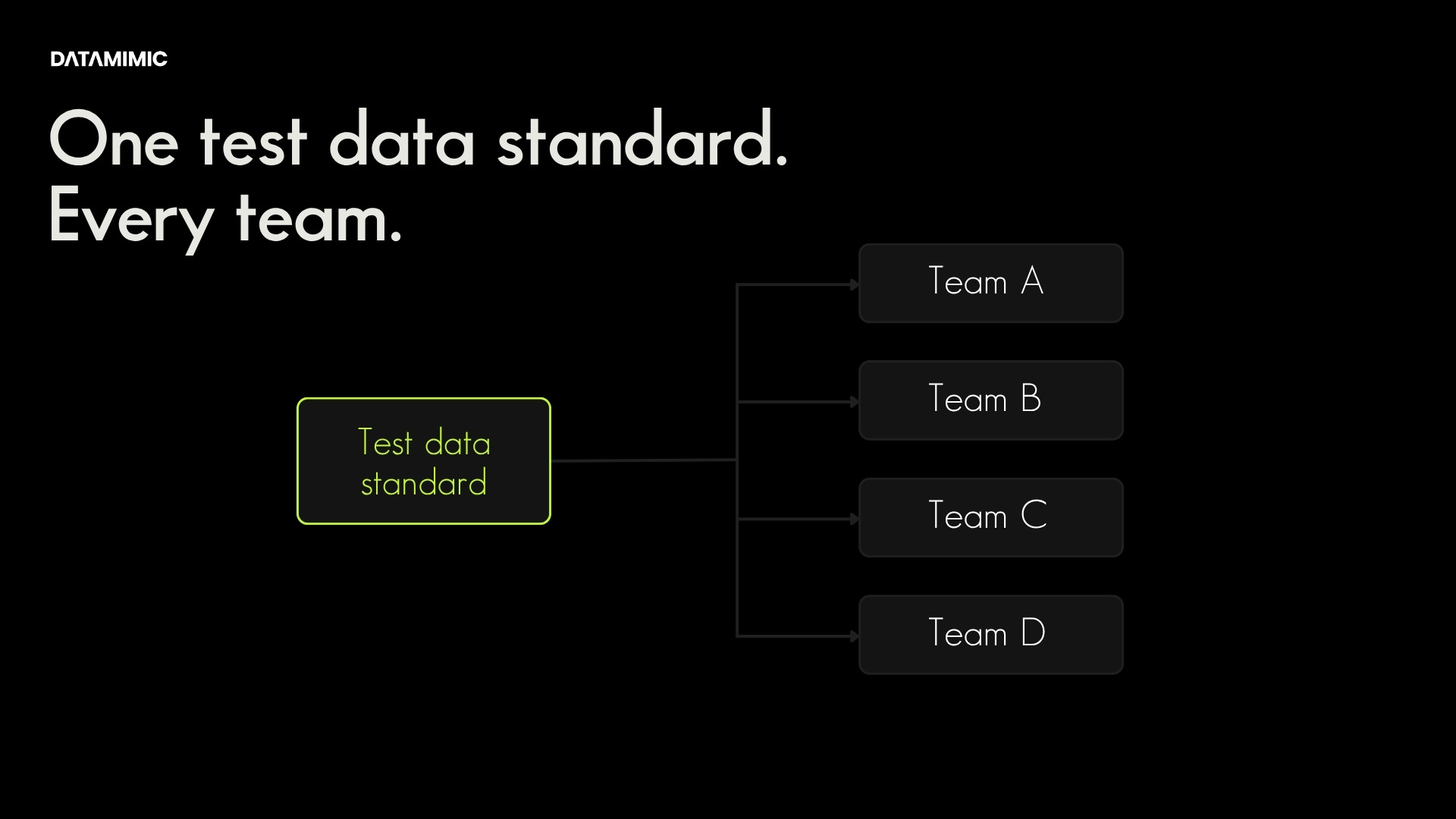
There is an organizational consequence here, and it is the reason the Platform is more than a UI over the engine. Tonic’s portfolio is three products, and adopting one is a per-workload tooling decision. The DATAMIMIC Platform is built to be adopted as the organization’s one standard for test data: shared components live in global projects, new teams start from a template gallery instead of a blank page, and multiple users collaborate on one project without overwriting each other. In most enterprises the alternative is not a rival platform; it is every team maintaining its own test-data scripts, each drifting its own way.
The model-as-files approach also separates business from engineering. A project combines DATAMIMIC models and Python extensions (the technical artifact) with Excel or CSV files that hold the domain’s data classes (the business artifact). A requirements engineer maintains the product catalogue or the segment definitions in a spreadsheet; nobody asks them to read XML, and no engineer has to transcribe business rules out of a meeting.
Tonic AI competitor check: when is Tonic the right answer?
Match the job to the tool:
- Unstructured data is the center of gravity. Free text and PDF de-identification is what Tonic Textual is built for, as a dedicated product.
- You want to try synthetic data this afternoon, self-serve. Among synthetic test data generation tools with a public free tier, Tonic Fabricate exists for exactly that. DATAMIMIC’s equivalent entry point is CE via pip, MIT-licensed; the Platform is an engagement with your architecture team, not a signup form.
- Your stack is general relational and warehouse masking with no message-standard or byte-level reproducibility requirement, and your team prefers UI-driven configuration. Tonic Structural was designed for that workflow.
- You are building LLM pipelines on OpenAI’s Agents SDK or LangChain and want de-identification wired into those specific frameworks.
When is DATAMIMIC the right answer?
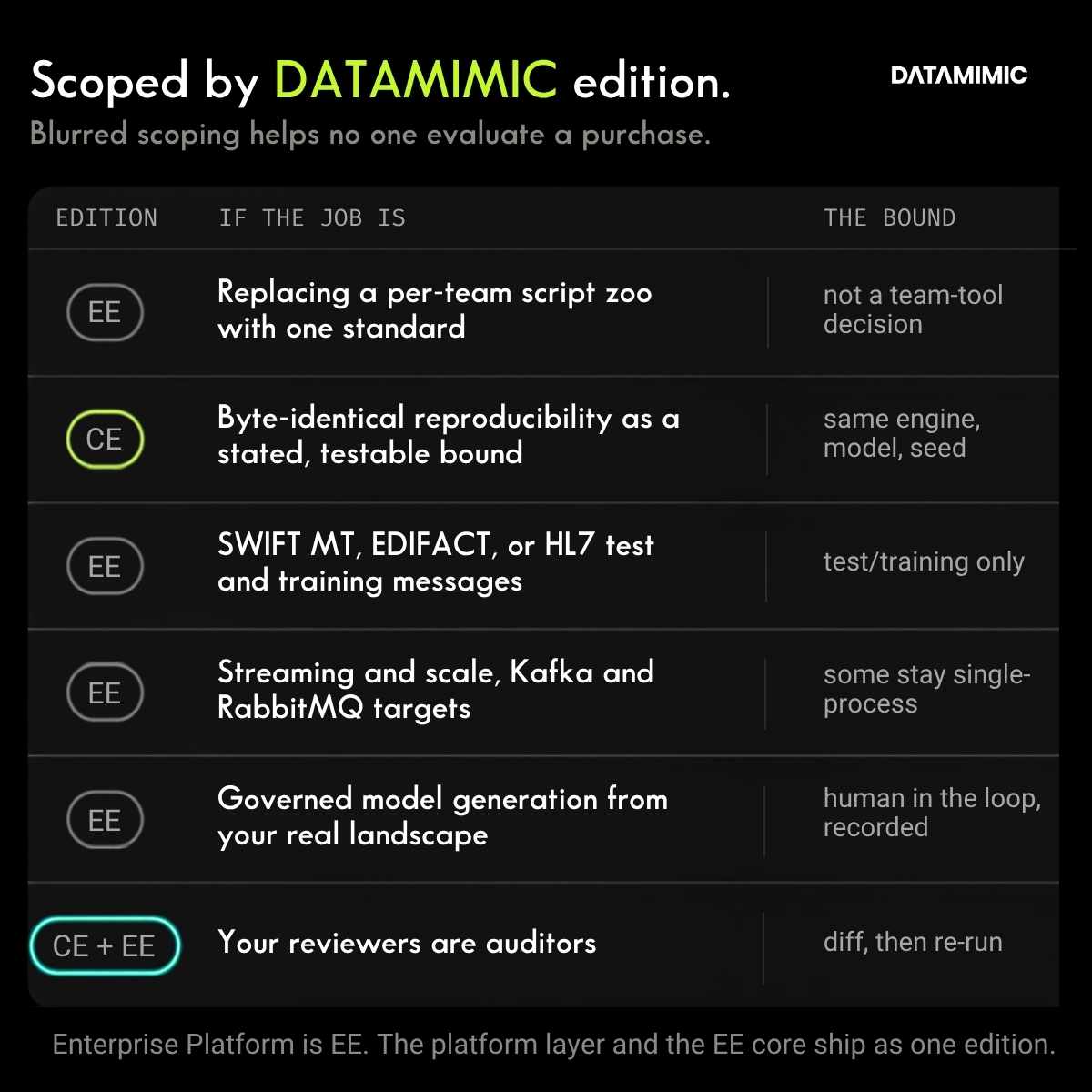
Scoped by edition, since blurred scoping helps no one evaluate a purchase:
- You are replacing a per-team script zoo with one standard. The Platform defines how test data is modelled, generated, de-identified, and distributed across environments for the whole organization, with global projects, a template gallery, and multi-user collaboration as the sharing mechanisms. This is a platform decision, not a team-tool decision, and it is the main reason enterprises engage beyond CE.
- You need byte-identical reproducibility as a stated, testable bound. CE, MIT-licensed, with the three-input guarantee quoted above and value-keyed pseudonymization by construction. Connectors for PostgreSQL, Oracle, MySQL, MS SQL Server, SQLite, MongoDB, and CSV/JSON/XML files.
- You need SWIFT MT, EDIFACT, or HL7 test and training messages generated from the same models as your database data. That is an Enterprise Platform capability (template engine), not CE, and it carries a real limit: test/training use only, not SWIFT CSCF-compliant for production transmission. ISO 20022 formats such as pacs.008 and pain.001 sit on the same framework but are built per customer engagement, not shipped as a stock catalogue item.
- You need streaming and scale. EE adds Apache Kafka and RabbitMQ targets and distributes generation across independent worker processes wherever a distribution’s mathematics allow it, with parallel output byte-identical to single-process output, asserted in CI. Some distributions stay single-process by design; we say so rather than claiming linear everything.
- You need governed model generation from your real landscape. The Platform scans sources relationships-and-all, generates pseudonymization or anonymization models, trains auto-regressive ML generators for subsetting or scale-up, and keeps a human in the loop on every PII decision, recorded.
- Your reviewers are auditors. In CE, the model is code: a reviewer reads a diff instead of inspecting a database after the fact, and can re-run the same engine version, model, and seed to reproduce byte-identical output independently. EE additionally logs a structured run record, task ID, model version, content hash, for every execution.
FAQ
Is Tonic.ai's masking deterministic?
Per Tonic’s own documentation, deterministic masking is one available technique. Their docs do not specify whether it is the default, nor whether output is byte-identical across runs or consistent at the value-mapping level. If byte-level reproducibility matters to you, ask them that question directly and precisely. DATAMIMIC states its bound explicitly: same engine version + same model (DSL) + same seed → byte-identical output, across machines and across time (CE, seeded rule-based generation; ML outputs are excluded).
Does DATAMIMIC automatically detect PII?
No, and that is deliberate. The Platform surfaces likely-PII fields through risk scoring and recommendations. A human reviews each recommendation, can override or hard-define any field, and the decision is recorded. Silent auto-classification is a liability, not a feature: when a regulator asks why a field was treated as non-personal, “the software decided” is not an answer. A recorded human decision is.
Is DATAMIMIC open source?
The execution core is. DATAMIMIC Community Edition is MIT-licensed and installable via pip today, including the XML DSL, the determinism guarantee, the value-keyed pseudonymization, and connectors for PostgreSQL, Oracle, MySQL, MS SQL Server, SQLite, MongoDB, and file formats. It does not include any banking or healthcare message-format generation. EE (Kafka, RabbitMQ, multi-process scaling, and the template engine that generates SWIFT MT/EDIFACT/HL7 as test/training artifacts) and the Platform (scan-to-model, ML generators, multi-user, PII review workflow) are commercial layers on top; ISO 20022 formats such as pacs.008 and pain.001 are available on the EE template framework per customer engagement rather than as a stock catalogue entry.
Tonic AI competitor pairing: can I use Tonic and DATAMIMIC together?
Yes, and some estates should. Not every pair on a shortlist of Tonic AI competitors is mutually exclusive: Tonic Textual on unstructured documents and DATAMIMIC on the payments and database side is a coherent split, each tool on the job it was built for. The mistake is stretching either across the other’s job, UI-configured masking where you need byte-identical CI evidence, or a message-grade generator where the workload is free-text redaction.
DATAMIMIC is the test data platform for regulated banking and insurance. It generates deterministic, reproducible, CI/CD-ready test data. The Enterprise Platform’s template engine additionally produces SWIFT MT, EDIFACT, and HL7 messages for test and training environments, without production data ever leaving your environment.

July 21, 2026
Facing a challenge with your test data project? Let’s talk it through. Reach out to our team for personalized support.

We’ve received your submission and will be in touch shortly